
South African critical minerals and beneficiation

Market Forces
South Africa wants minerals processed at home, but the rules are not there yet
What a Market Forces analysis finds on beneficiation, power tariffs and a closing smelter
Six findings from a Market Forces analysis of South Africa's critical minerals and beneficiation: local-processing duties that exist only as a draft bill and a proposal, a power price that is keeping ferrochrome smelters running, the last manganese smelter stopping, a temporary zero-tariff window into China, a proposed US investment platform, and the national strategy's ranking of which minerals matter most. Summarised here from the full report, with the source behind each finding.
This is a summary. The full report is open to read in Dexil.
6 findings, every claim traced to its source
 Open the reportPicture: generated with AI for Dexil.
South Africa wants more of its minerals processed at home before they are exported, an idea known as beneficiation. For a mining company the question is what it will be required to do, and when. The findings below suggest the answer is not yet in law.
Meanwhile the price of power is deciding which processing survives. A negotiated electricity tariff for ferrochrome smelters runs for years. The one manganese smelter outside that deal stopped in July. Trade policy is also moving: access to China's market is temporary, and a US investment platform is only a proposal.
That is the kind of question we built the platform to answer, so we ran it. Everything below comes from a single Market Forces analysis, and every finding carries the sources it was drawn from.
What the analysis found
Regulatory
Local processing is a policy direction, not yet a rule
The draft Mineral Resources Development Bill of 2025, approved by Cabinet for public comment, would require every mineral producer to make minerals available for local beneficiation (clause 26(c)). A legal submission notes that it gives no baselines or volumes. The dtic's Industrial Development Strategy of June 2026 calls a review of mining legislation on the allocation of rights critical, so that conditions can be attached to beneficiation, but it sets no thresholds. For a mining company this is a direction to plan for, not an obligation that attaches to a mining right today.
Economic
A power tariff is keeping ferrochrome smelters running
The energy regulator NERSA decided on 28 May 2026, and announced on 29 May, that Eskom will charge ferrochrome producers 62c/kWh from 1 June 2026: five years for Samancor Chrome and three for Glencore-Merafe. The price rises each 1 April by producer price inflation plus one percent, and any shortfall stays inside Eskom instead of being passed to other customers. Samancor cancelled retrenchments and plans to restart all its smelters within six months, and Glencore-Merafe is restarting its Boshoek and Wonderkop smelters. Electricity is roughly 35 to 40 percent of ferrochrome production cost.
Economic
The last manganese smelter has stopped
Transalloys halted all furnace operations on 1 July 2026, ending South African manganese smelting. It was not given the ferrochrome tariff. The regulator gave it a six-month relaxation of its take-or-pay requirement (a minimum amount of power it must pay for whether or not it uses it), effective 1 July. The company says 600 permanent jobs in eMalahleni, up to 7,000 dependants and about R6 billion of local investment are at stake, and that restarting cold furnaces is prohibitively costly. This is the position as at early July 2026; we found no later report.
Trade and geopolitics
China's zero-tariff access for South African exports is a two-year stopgap
China has applied zero tariffs to South African exports since 1 May 2026. The terms end on 30 April 2028. The scheme, called Early Harvest Lite, is temporary until China and the Southern African Customs Union (SACU) conclude a reciprocal agreement. China's commerce ministry describes it as zero tariff on 100 percent of tariff lines. South Africa's revenue service adds that tariff rate quotas, which cap the duty-free volume, apply to some products. Exporters also need a certificate of origin. Any China offtake contract that runs past April 2028 sits beyond the current terms.
- China's Zero-Tariff Preference Scheme (SARS)
- China's Zero-Tariff Preference Scheme (SARS), quotas
- China grants South Africa 100% zero-tariff access to its market under new partnership deal (Global Times, quoting MOFCOM)
- China and South Africa advance battery mineral refining pact (East Asia Brief, the report's own source)
Trade and geopolitics
South Africa has proposed, not agreed, a US critical minerals investment platform
On 24 September 2026, at the UN General Assembly, trade minister Parks Tau proposed a Critical Minerals Investment Platform. It would pair South African funders, including the Industrial Development Corporation (IDC), with US bodies such as the Development Finance Corporation and EXIM Bank. He also proposed a South Africa-USA working group to match projects with US demand, find finance and address market access. Both are proposals. Tau said the work should not become another dialogue mechanism without implementation. No members, funding or timetable were published in the speech report.
Regulatory
The national strategy ranks chrome, manganese and coal above lithium, cobalt and graphite
South Africa's Critical Minerals and Metals Strategy scores each mineral on eight indicators, including export potential, jobs and supply risk. Five rate high-critical: platinum, manganese, iron ore, coal and chrome ore. Gold, vanadium, palladium, rhodium and rare earths rate moderate to high. Copper, cobalt, lithium, graphite and nickel rate moderate. The strategy says the list gives investors predictability, and that it will be reviewed as markets change. A battery-minerals developer should note that the state's stated priority sits with steel inputs and bulk commodities.
Run this on your own market
Everything above is a summary. The full report carries much more detail and insight: every finding, the evidence under it, and the sources behind each one. It was produced on the same platform our customers use, and the free tier will get you through your own first one.
How this was produced
- Question submitted
- “South African critical minerals and beneficiation”
- Analysis ID
- STG_Indaba_CritMin_MFv4_2026-10-02_100741
- Executed
- 2 October 2026
Module overview
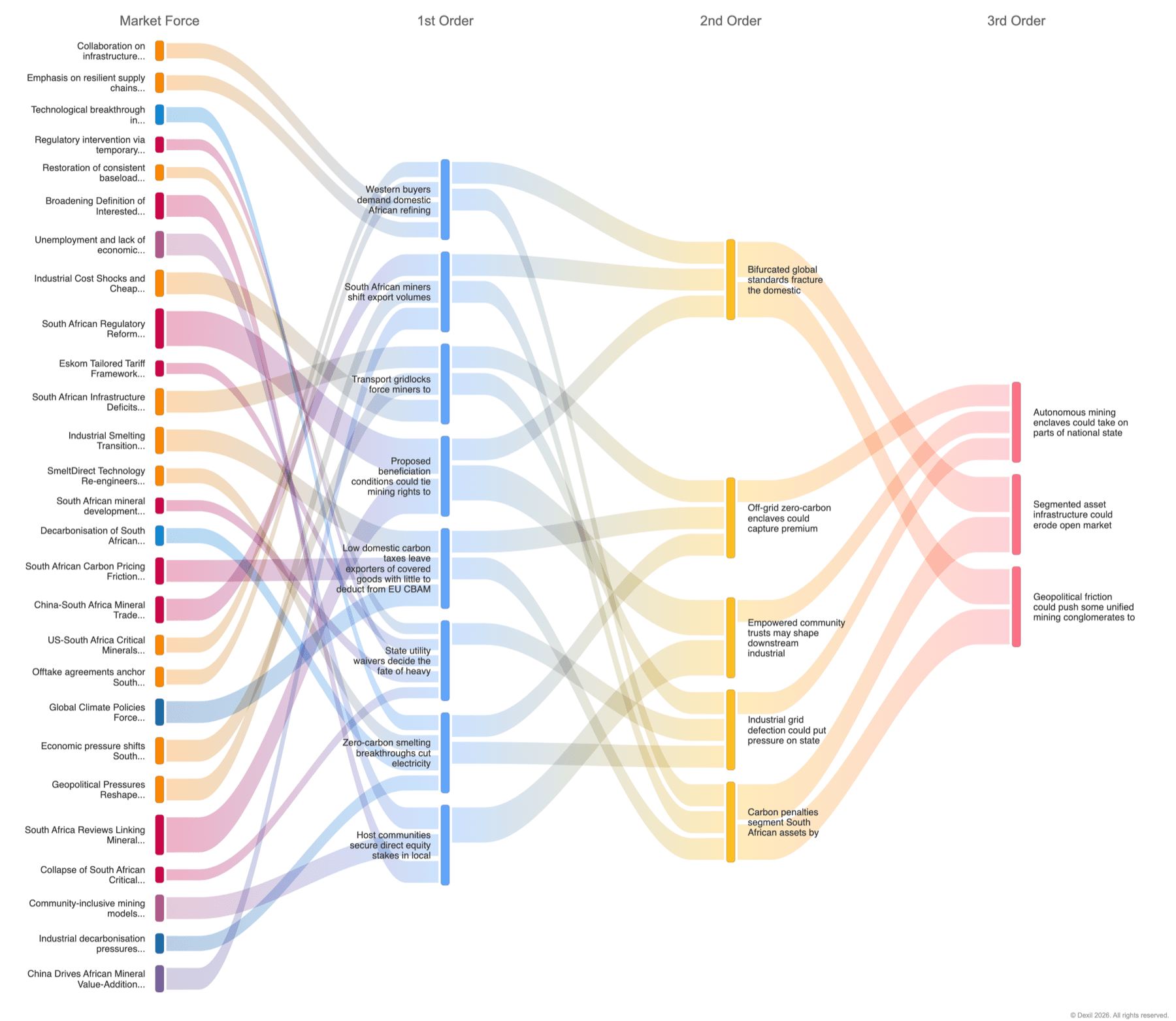
We asked the Market Forces module the question above. It searches for sources, extracts the distinct forces acting on the topic, and traces first, second and third-order effects.
We then checked the figures and claims against government and regulator documents where they exist, and left out the ones that did not hold up. Where a finding rests on press reporting, a company's own announcement or test-work results rather than a primary document, the finding says so.
We commissioned this analysis ourselves, on a subject we picked, using the same platform our customers use. No customer data went into it. Every finding links to the sources the analysis cited for it. It is still AI-generated analysis: a starting point for your own judgement, not a substitute for it.
See our AI disclaimer for the limits that apply to all Dexil output.