
South African mining logistics, power and regulation

Market Forces
South African mining's grid, rail and licensing reforms are mostly still to come
What a Market Forces analysis finds on power, rail and mining rights
Six findings from a Market Forces analysis of South African mining logistics, power and regulation: a state-owned grid operator, a power tariff for smelters, private rail, a digital register of mining rights, a draft mining Bill and a grid build shortfall. Summarised here from the full report, with the source behind each finding.
This is a summary. The full report is open to read in Dexil.
6 findings, every claim traced to its source
 Open the reportPicture: generated with AI for Dexil.
Mining in South Africa depends on three things the state largely controls: the electricity grid, the rail network and the system of mining rights. All three are being reformed.
Each finding below comes with a date, and most of those dates are still ahead. A grid operator is endorsed with the transfer about 18 months away. Private trains mostly run during 2027. The national register of mining rights is promised for 31 March 2027. For a mining company, the question is what to do in the gap between the announcement and the delivery.
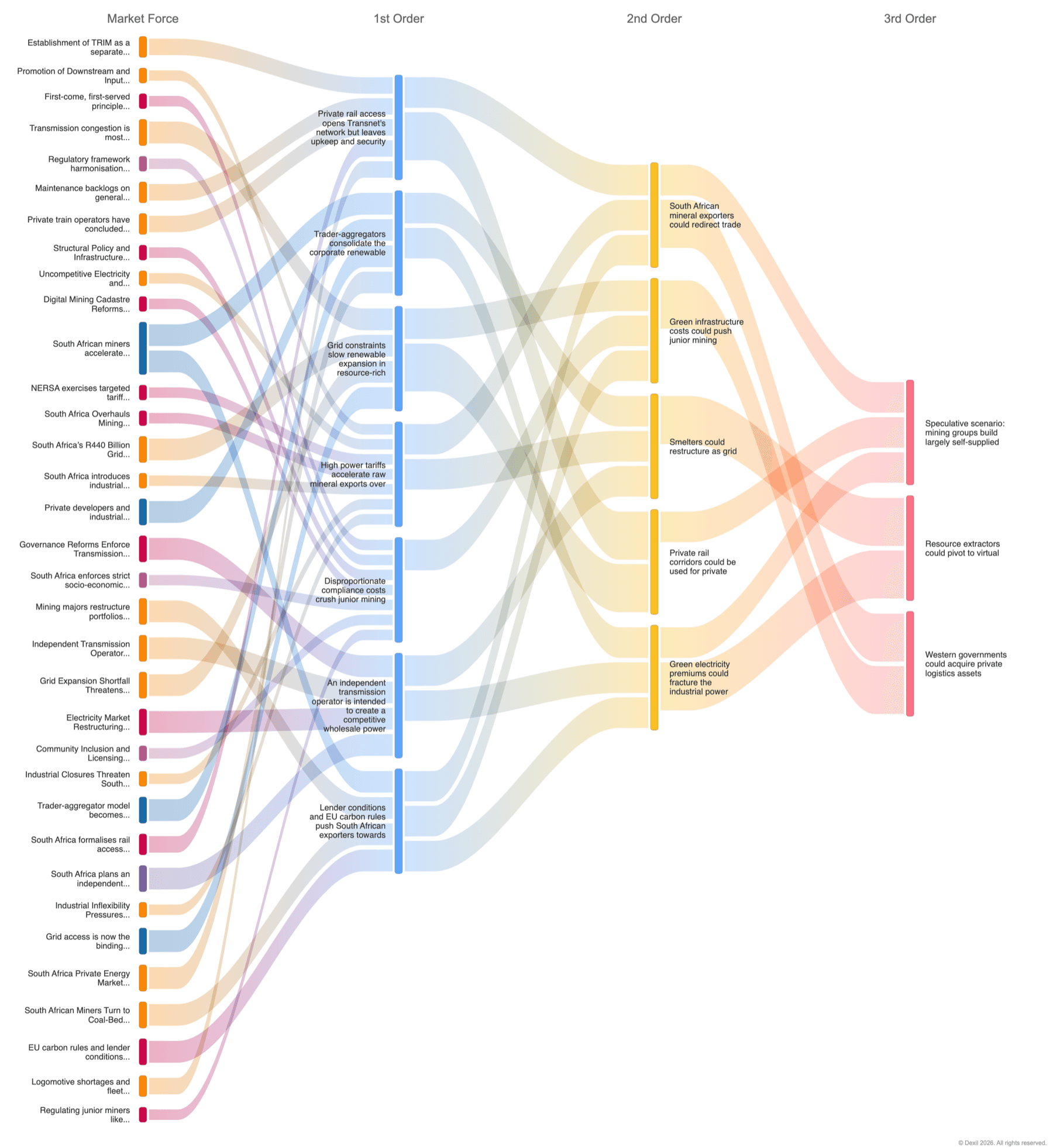
That is the kind of question we built the platform to answer, so we ran it. Everything below comes from a single Market Forces analysis, seeded with two government documents, and every finding carries the sources it was drawn from.
What the analysis found
Regulatory
A state-owned grid operator is endorsed, with the transfer about 18 months away
On 31 July 2026 the Presidency endorsed the Phase I report of the Eskom Restructuring Task Team. It describes an independent, state-owned Transmission System Operator, separate from Eskom, that takes ownership and control of the grid. The National Transmission Company has been an Eskom subsidiary since July 2024. National Treasury's director-general says the transfer should take about 18 months, with interim governance rules to strengthen the company's independence first. For a mine, the practical change is who decides grid access and connection queues. That is still a proposal on a timetable.
Economic
Ferrochrome smelters get a 62c/kWh tariff, and one manganese smelter gets a waiver
On 28 May 2026 NERSA approved amended pricing agreements for Samancor Chrome (five years) and the Glencore-Merafe Chrome Venture (three years), both from 1 June 2026. Eskom will charge 62c/kWh, escalated each 1 April by producer price inflation plus 1%. NERSA says the earlier 12-month relief left the tariff above breakeven for most smelters. It also relaxed Transalloys' 70% take-or-pay requirement (a minimum amount of power it must pay for whether or not it uses it) for six months from 1 July 2026. Any shortfall stays inside Eskom and is not recovered from standard customers. The relief was negotiated producer by producer, so other energy-intensive producers cannot assume they will qualify.
Economic
Private rail adds about 24 Mt of capacity, against 65 Mt in the national plan
Eleven private train operators concluded access agreements with Transnet's infrastructure manager, confirmed at a ceremony on 13 May 2026. They are expected to add 24 million tonnes of capacity a year. Some plan to start before the end of 2026, but most are expected to run during 2027. Transnet's 250 million tonne national goal, dated 2030 in this source, assumes about 185 Mt from Transnet Freight Rail and 65 Mt from private operators. Transnet expected about 168 Mt for 2025/26. On those figures private operators cover about a third of the private share the plan assumes.
Regulatory
The national register of mining rights is promised for 31 March 2027, after missed dates
The Director-General of the Department of Mineral and Petroleum Resources said at the Junior Mining Indaba on 9 June 2026 that the national rollout of the digital mining cadastre, the register of mining rights and applications, would be done by 31 March 2027. It replaces the SAMRAD system. The Western Cape pilot has migrated, but national rollout depends on each province's data being ready. Earlier dates, including June 2025, were missed. Until it works, applications and rights ownership stay hard to see. The date is a stated target reported in the press.
Regulatory
The draft Mining Bill could add 40% to 60% to compliance costs, one research group estimates
The draft Mineral Resources Development Bill was published in May 2025 and was open for comment until 13 August 2025. Economic Research Southern Africa estimates that compliance already takes 30% to 40% of company operating budgets and would rise by another 40% to 60% if the draft is enacted as written. A University of Cape Town submission says the draft gives the Minister broad discretion to restrict mineral exports. These are estimates and critiques of a draft, and the final text may differ. We found no sign that it has been introduced to Parliament.
Economic
The grid is the bottleneck: 270.8 km of lines built against a 423 km target
The National Transmission Company says it built 270.8 km of lines in 2025/26 against a 423 km target, citing contractor financial constraints and underperformance. It also says it needs about R134 billion of extra funding over five years and cannot deliver the programme alone. That matters to miners buying private renewable power, because new connections wait on the same grid. The figures are reported by an energy consultancy and appear in press coverage.
Run this on your own market
Everything above is a summary. The full report carries much more detail and insight: every finding, the evidence under it, and the sources behind each one. It was produced on the same platform our customers use, and the free tier will get you through your own first one.
How this was produced
- Question submitted
- “South African mining: logistics, power and regulatory reform”
- Analysis ID
- STG_Indaba_Logistics_MFv4_2026-10-02_100807
- Executed
- 2 October 2026
Module overview
We asked the Market Forces module the question above. It searches for sources, extracts the distinct forces acting on the topic, and traces first, second and third-order effects.
We then checked the figures and claims against government and regulator documents where they exist, and left out the ones that did not hold up. Where a finding rests on press reporting, a company's own announcement or test-work results rather than a primary document, the finding says so.
We commissioned this analysis ourselves, on a subject we picked, using the same platform our customers use. No customer data went into it. Every finding links to the sources the analysis cited for it. It is still AI-generated analysis: a starting point for your own judgement, not a substitute for it.
See our AI disclaimer for the limits that apply to all Dexil output.