
Mining technology in South Africa and Africa

Tech Intelligence
Mining technology in South Africa: what is working and what is still a plan
What a Tech Intelligence analysis finds on battery minerals, automation and mine power
Six findings from a Tech Intelligence analysis of battery minerals, mining automation, AI and mine power in South Africa and Africa: a working manganese plant, an automated drill rig, mine solar without batteries, the first solar-plus-battery plant for a mine, a supplier's AI claim, and how ready South African mining is for AI. Summarised here from the full report, with the source behind each finding.
This is a summary. The full report is open to read in Dexil.
6 findings, every claim traced to its source
 Open the reportPicture: generated with AI for Dexil.
South African miners are being pushed towards new technology from three directions: the need to process battery minerals at home, the cost and reliability of power, and the pull of automation. The findings below show where each is working in South African mines today, and where the examples come from elsewhere.
The strongest local examples are in battery minerals and mine power: a manganese plant being commissioned and solar plants running at scale. Automation is earlier: one automated drill rig at one mine. And the first solar-plus-battery plant for a mine in Africa is in the DRC.
That is the kind of question we built the platform to answer, so we ran it. Everything below comes from a single Tech Intelligence analysis, and every finding carries the sources it was drawn from.
What the analysis found
Battery minerals
South Africa has a first-phase battery-grade manganese plant, and the next one is planned for Botswana
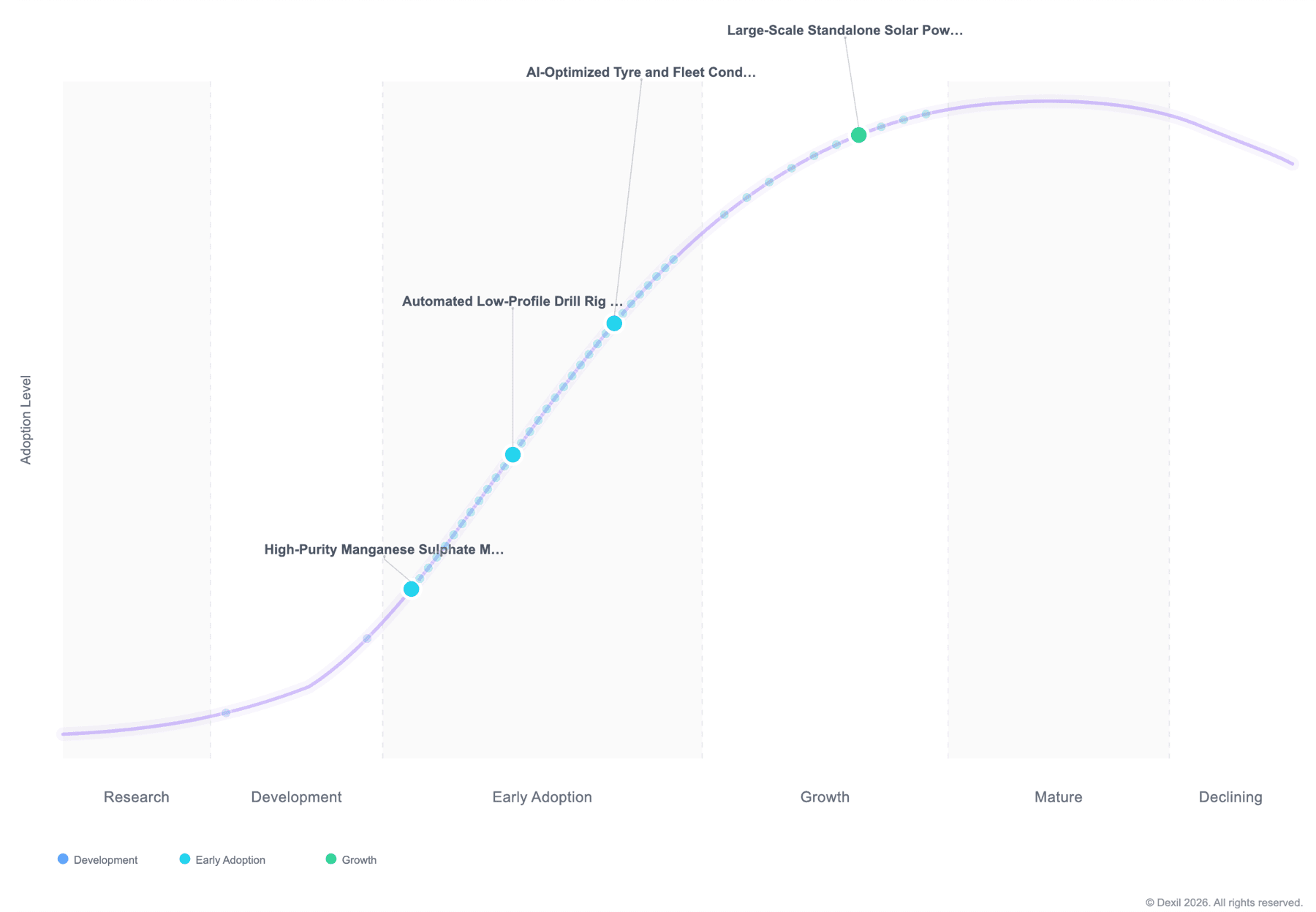
Manganese Metal Company has completed construction of the first phase of a plant at Mbombela, in Mpumalanga, that makes battery-grade manganese sulphate, a chemical used in battery cathodes. It is being commissioned at 6,000 tonnes a year, with a larger second phase under evaluation. Giyani Metals, a Canadian developer, made the same chemical at a demonstration plant in Johannesburg and received a further R29.9 million from the Industrial Development Corporation. Its full-scale plant is planned for Botswana, not South Africa. South Africa therefore has one plant being commissioned and no second plant committed.
- South Africa’s battery materials supply status surges ahead with new MMC plant
- The Birth of Battery and Magnet Manufacturing in Southern Africa | Business Tech Africa
- Canada’s manganese demo plant in Joburg gets extra funding from South Africa’s IDC
- Giyani Produces High Purity Manganese Sulphate Monohydrate from Demo Plant
Automation and robotics
A first automated low-profile drill rig now works at a South African chrome mine
Mine Master, with Komatsu Underground Hardrock South Africa, has commissioned its FLP1410 drill rig at Dwarsrivier chrome mine in the Assmang Group's Eastern Limb. The makers call it the country's first automated low-profile single-boom rig. It works in tunnels from 1.6 metres high, which suits chrome, platinum and narrow-reef gold mines. Once the rig is drilling on its own, the operator can watch from a safer distance instead of standing at the rock face. This is one machine at one mine, described by its maker, so it is an early signal and not yet a trend.
Renewable power and storage
Mine solar in South Africa is running at scale, mostly without batteries
Richards Bay Minerals' 148 MW Bolobedu solar plant is set to supply about 300 GWh a year and cut the operation's emissions by at least 10%. Exxaro's 68 MW Lephalale plant reached commercial operation on 20 April 2026 and is expected to save about R100 million a year at Grootegeluk mine. It should cut Scope 2 emissions, which come from bought-in power, by about 17%. Exxaro's site is licensed for storage later, so neither plant stores power today. Solar is the proven part of the answer to Eskom's constraints.
Renewable power and storage
Africa's first solar-plus-battery baseload plant for a mine is in the DRC, not South Africa
CrossBoundary Energy says its plant for Kamoa Copper in the Democratic Republic of Congo reached commercial operation on 12 August 2026. It pairs 233 MWp of solar panels with a 526 MWh battery to supply at least 30 MW around the clock, and CrossBoundary owns and operates it. The largest South African project in the analysis is TotalEnergies' Hydra in the Northern Cape, with 216 MW of solar and 500 MWh of storage. It sells 75 MW to the national grid under a 20-year contract with Eskom, not to a mine. For South African mines, storage is still a plan.
- Africa’s first solar and battery baseload facility reaches commercial operation in record time, signalling a new era for round-the-clock renewable power
- DRC solar-battery project brings baseload renewable power to Kamoa-Kakula copper mine
- TotalEnergies switches on Hydra, Africa's largest hybrid renewable project, in the Northern Cape
AI for operations
A tyre supplier says AI cuts mine downtime by up to 20%, with no mine result published
At Electra Mining Africa, Kal Tire showed AI tools that flag early tyre damage such as hot spots and tread damage, and haul-road faults such as spillage and non-compliant berms. The headline figure is 'up to 20%' less downtime. The article names no mine and gives no measured result. It says 25 of the systems run in Canada, Australia, Chile and Colombia, with Zambia's due within weeks, so none was reported at a South African mine. A miner can ask the supplier to prove the 20% on its own fleet.
Adopt versus build
South African mining was not yet ready for AI at full scale in May 2026, an industry cluster said
Mining Weekly's report on the tenth anniversary of the Mining Equipment Manufacturers of South Africa cluster says South African mining was not yet ready for AI at full scale. Globally, it says, mining sits between advanced experimentation, selective piloting and scaling, and South Africa is earlier on that curve. It adds that each technology should have a clear value proposition and a practical understanding of the problem it solves. The same report says the sector needs to move from consuming technology towards developing, owning and exporting it.
Run this on your own market
Everything above is a summary. The full report carries much more detail and insight: every finding, the evidence under it, and the sources behind each one. It was produced on the same platform our customers use, and the free tier will get you through your own first one.
How this was produced
- Question submitted
- “Technology domains: Battery minerals and metals processing, mining automation and robotics, artificial intelligence. Industry: Mining. Geography: South Africa and Africa. Horizon: next 10 years. Context: manganese, vanadium, PGMs and chrome and local processing; automation, remote operations and robotics in deep-level and open-pit mining; AI for exploration, predictive maintenance, safety and process optimisation; renewable power and storage at mine sites given Eskom constraints; what South African miners must adopt versus build locally.”
- Analysis ID
- Indaba-TI-Integrity_TI_2026-10-04_051337
- Executed
- 4 October 2026
Module overview
We asked the Tech Intelligence module the question above. It searches for current technologies in each domain, reads the sources it finds, and groups what it learns into technologies, themes and recommended actions.
We then checked the figures and claims against company, regulator or institutional documents where one could be reached, and left out the ones that did not hold up. Where a finding rests on press reporting, a company's own announcement or test-work results rather than a primary document, the finding says so.
We commissioned this analysis ourselves, on a subject we picked, using the same platform our customers use. No customer data went into it. Every finding links to the sources the analysis cited for it. It is still AI-generated analysis: a starting point for your own judgement, not a substitute for it.
See our AI disclaimer for the limits that apply to all Dexil output.